
A vision-impaired
person of sound mind experiences
phantom images (visions) in
their visual field.
National helpline
1300 121 123

A vision-impaired
person of sound mind experiences
phantom images (visions) in
their visual field.
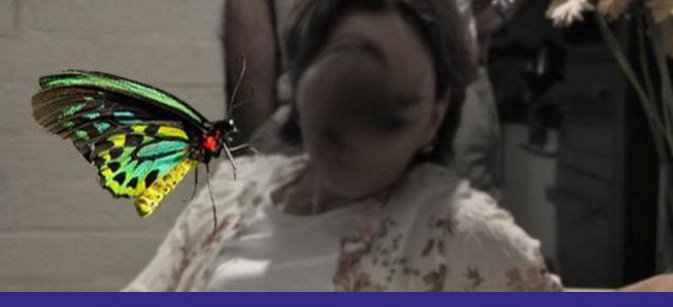

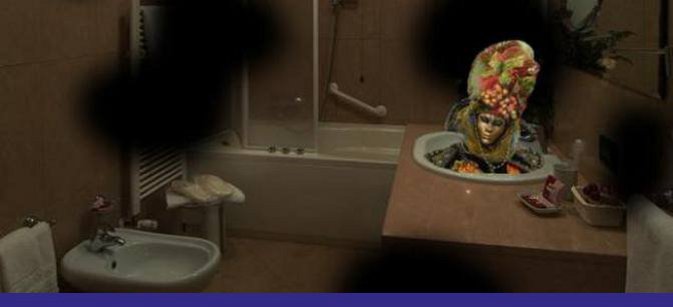


The Foundation continues its presentation of video snippets kindly supplied by Australian PhD candidate, Vicky Hamilton. Vicky is undertaking her CBS study at Griffith University, Queensland. In this second edition, a further illustration of a CBS episode from one of Vicky's subjects. This time, Bonnet appears in the form of World War II soldiers who appear in the subject's bedroom.
World War II visual images are rather common in CBS. This may be in part due to the fact that many people living with CBS actually lived through the Second World War period.
The depiction presented here is from subject 34 and her war-related visions. Vicky has indicated that the video shown is a creative work in progress. It's an evolving co-creation between the researcher and the participant. Vicky anticipates that the final videos will be accompanied by audio. To learn more about Vicky's work: https://cbsvisions.com/
Hamilton, V.H. & Participant 34. (2024) World War II visions [Video]
Summary to Subject 34's personal account:
"A picture of a woman in a bedroom. Visions from war invade the scene; two soldiers wearing the distinct circular hats emerge like ghosts from the past. Her thoughts drift to World War II."
Any queries relating to the study (including requesting permission to use any material) please contact one of the researchers:
Prof Andrew Brown
p “ (0)7 3735 6252
Ms Victoria Hamilton
p “ 0408 723 276
Dr. Annmaree Watharow lives in Sydney, Australia. She has Usher syndrome (dual sensory loss) and around the time she started to lose her vision, Charles Bonnet syndrome commenced and has continued ever since. Annmaree was trained as a doctor and currently is working as a Research fellow at the University of Sydney [Centre for Disability Research and Policy]. This is her story which has been kindly shared with the Foundation. The accompanying pictures are depictions of her CBS experience.
Living with CBS by Annmaree Watharow
For forty years I have lived with a well-dressed man. He has dark hair, an indistinct face and wears a very smart black suit with a white shirt and a burgundy tie. The dark suit is double breasted with shiny buttons that sparkle in the sunlight. He is not real. He doesn't have a face but he has been visiting me for almost forty years.
At first, for a long time, I didn't know what he was doing popping out at me in all sorts of places: dim, romantic restaurants, dark hallways, alleyways at night, in the street. In Sydney, in Melbourne, in Toronto, Ontario, in London, France and Hong Kong. If I travelled so did he. I knew he wasn't real, but I didn't know precisely what it meant. That was seeing people that weren't real. I was reasonably confident my brain was working just fine but then people with serious mental illness believe this too, so how could I really tell?
I noticed my vision deteriorating when I was fourteen or fifteen years old. I told three ophthalmologists in one year I couldn't see at night. They told me to eat more carrots. I told them I kept falling over and into things like ponds, jetties and rubbish bins. They said go to a physiotherapist for clumsy people, we can't help you. The man in the dark suit kept springing out at me no matter what I did or anyone said.
When my medical training finished, I moved quickly from hospital work (night shifts were too difficult) to being a therapist in the community. The man in the dark suit came to work with me sometimes (you just never knew when). One day I read about Charles Bonnet syndrome, about how Bonnet's grandfather had these spectacular ˜fictions of the mind' where he saw, as if they were real, horses and carriages and fine ladies on streets. This grandfather was blinded with severe cataracts. Aha. I thought. This is it. Low vision? Check. Visual hallucinations? Check. Intact brain function? Check (I hope).
Never have I been asked about seeing the unseen by any doctor of any sort. And that's terrible. So much secret worry could be avoided if the professionals looking after us knew more, investigated well and reassured most of us. I am lucky my man in the dark suit isn't frightening in himself, he gives me a brief startle when he jumps out at me but that is more because as women, we are rightly wary of strange men in dark places.

Image: Watercolour painting of man with no face in a grey suit and burgundy tie.
I have other visual hallucinations that started more recently, in times of stress such as jet lag and being unwell. The first is when I kept seeing weird times on my large font analogue watch: first it was eleven ten, then five minutes later it would be a quarter to three. The time changed (wrongly so) every time I looked at it. I could only tell the time if I looked at the digital time on my phone. So, this was easily solved. I got a digital watch and never wore an analogue one again.
The next hallucination took place in a bar in New York City. I had just arrived and was exhausted from what felt like two days of non-stop travel. At first, I thought my drink was spiked when I began seeing little palm trees everywhere; in the bar, the street, my hotel room. I knew then this was CBS. It can be tricky crossing roads when the pygmy palms take over the place but I am usually with someone who can't see them so all is well. I don't mind these palm trees; they are bright green and cheerful when there aren't too many of them. In a hotel recently, I saw them again, strangely spaced out and orderly. I told my husband the palm trees were out and about again. He laughed and took a photo of the wall showing the palm tree covered wallpaper! So very occasionally CBS is not responsible.
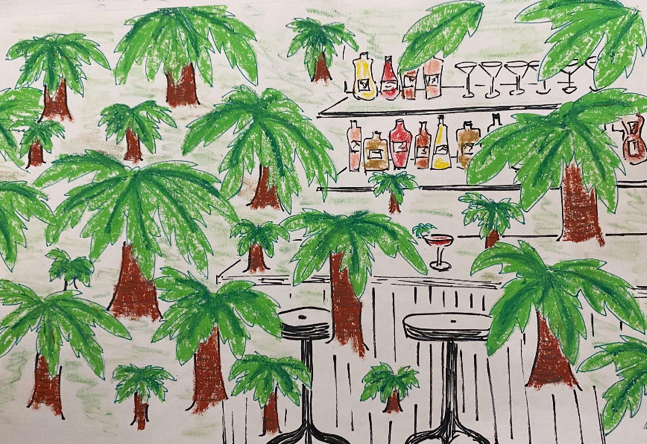
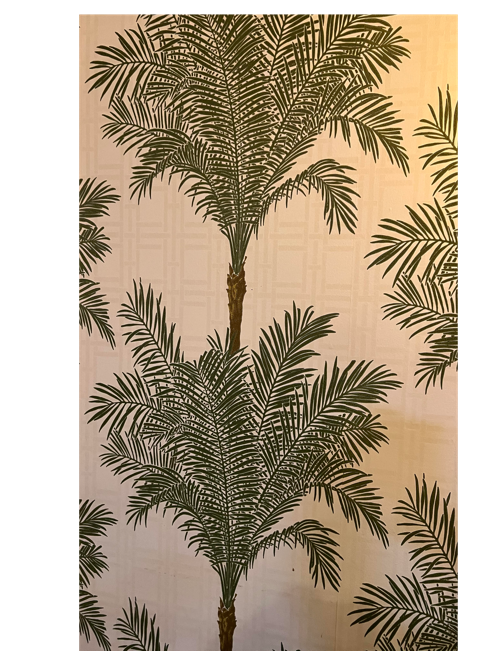
Image: Oil pastel picture of pygmy palms scattered around a New York bar. Far right image: Photo of palm tree wallpaper
What we need are:
Annmaree has a new book coming out later in the year that focuses on dual sensory disability. One chapter from that book will focus entirely on Charles Bonnet syndrome. The Foundation will provide updates once the work is published.
Australian PhD candidate, Vicky Hamilton, of Griffith University in Queensland is now in the latter stages of her CBS study. Her work is scheduled to be completed sometime in the new year.
One of the facets of her study is to collect people's personal accounts of their CBS and try to depict those visions in a way that can be made accessible to a wider audience: for example, an installation display at an art exhibition. Vicky has very kindly made available to the Foundation a few snippets of her project, which will be featured over coming weeks. To learn more about Vicky's work, please visit: https://cbsvisions.com/
The first depiction to be presented here is from subject 50 and the visions encountered in her bedroom:
Hamilton, V.H. & Participant 50. (2024) Childhood Checkers [Video]
Subject 50's personal account that led to the above:
"Why am I seeing this, what is happening to me? I have sight loss but didn't associate it with that, until I told my optician what was happening. Once I knew what was happening, they were beautiful little drawings. A lot like those my grandchildren and children drew when they were young. It's usually when I wake up in the morning after I've got up and I'm coming back into the bedroom. The room, the ceiling, the wall, the carpet, and the bed is covered from top to bottom... it was like a checkerboard. All very brightly coloured: pink, blue, yellow, green, orange, and purple. The visions where pleasant once I realised what was happening."
Any queries relating to the study (including requesting permission to use any material) please contact one of the researchers:
Prof Andrew Brown
p “ (0)7 3735 6252
Ms Victoria Hamilton
p “ 0408 723 276
Often when people look online for information about CBS - particularly possible treatments - they will come across comments that there is no treatment let alone a cure. At a general practitioner or specialist consultation, some patients are told, "there's nothing we can do for you". To read this online or to hear directly from a medical practitioner can be really deflating. However, these views are somewhat misleading because occasionally medical interventions are indeed effective.

[Image courtesy of Towfiqu Barbhuiya]
The Foundation wishes to outline the actual state of affairs when it comes to medically treating CBS:
The Charles Bonnet Syndrome Foundation is dedicated to raising awareness of CBS, what signs to look out for and how to better manage this condition.
As a charitable organisation, we rely principally upon memberships and donations to continue our work.
Please help us to support more people affected by CBS.
